
How to Scale a D2C Skincare Brand in India: A Practical Growth Playbook

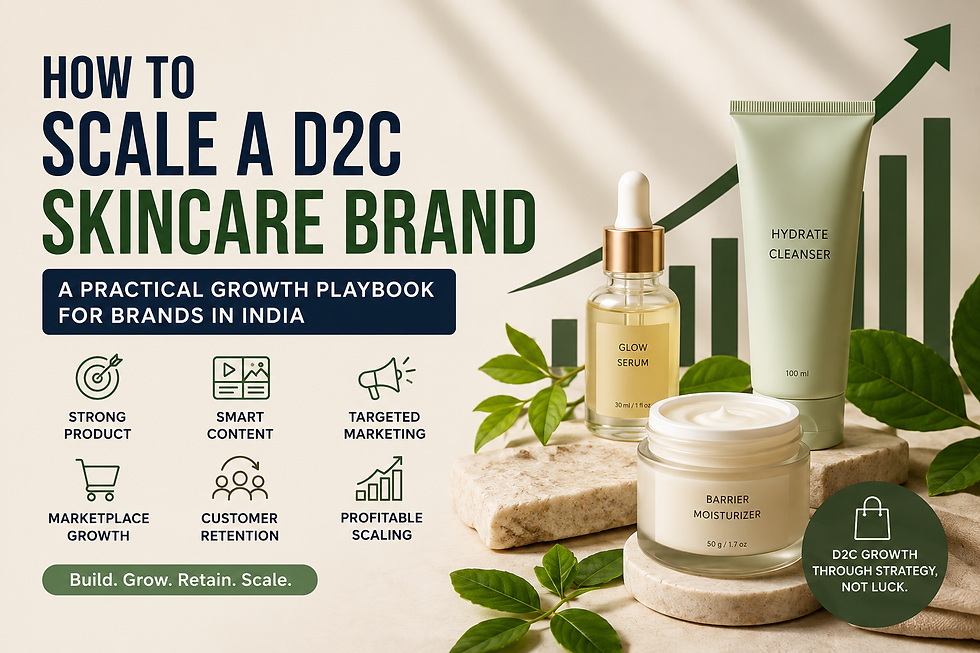
To scale a D2C skincare brand, build growth around a differentiated product, credible education, repeat purchases and profitable distribution. Start with one clear customer problem, strengthen conversion and retention, and then expand acquisition through creators, paid media, marketplaces and retail. Increasing advertising alone rarely produces sustainable skincare growth.
Key Takeaways
Definition: Scaling a D2C skincare brand means increasing profitable demand without allowing acquisition costs, discounts, inventory or operating expenses to grow faster than contribution margin.
Main benefit: A focused growth system creates more predictable acquisition and repeat purchases.
Important process: Strengthen positioning, conversion and retention before aggressively increasing media spend.
Main risk: Scaling unprofitable products or weak retention can turn higher revenue into greater cash-flow pressure.
Recommended next step: Identify the biggest constraint in your funnel and solve it before adding another channel.
India’s skincare category continues to attract consumer and investor interest. One market estimate valued the Indian skincare market at USD 9.06 billion in 2025 and projects it to reach USD 18.38 billion by 2034. The exact forecast varies by source, but the direction is clear: demand is expanding, while competition for attention and distribution is becoming more intense.
What Does It Mean to Scale a D2C Skincare Brand?
D2C skincare scaling is the process of increasing revenue, customer reach and repeat purchases while maintaining sustainable unit economics, inventory availability and customer trust.
Growth and scaling are not identical. A brand can grow revenue by offering deeper discounts or spending more on ads. It scales only when the additional revenue produces an acceptable contribution margin and can be repeated without creating operational instability.
A skincare growth engine is the connected system through which product positioning, content, acquisition, conversion, retention and distribution reinforce one another.
A strong growth engine does not depend on one viral Reel, one creator or one high-performing advertisement. It creates multiple ways for customers to discover, evaluate, purchase and repurchase the products.
1. Start With a Focused Product and Positioning Strategy
The first step is not to increase advertising. It is to make the product easier to understand and easier to choose.
Customers should quickly understand:
Who the product is for?
Which skin concern it addresses?
What role it plays in a routine?
Why it is different from similar products?
What evidence supports its claims?
When users can reasonably expect to assess the experience?
A vague promise such as “healthy, glowing skin” places the brand against hundreds of alternatives. A more focused positioning direction could be:
Lightweight sunscreen for humid Indian conditions
Barrier-support routine for over-exfoliated skin
Beginner-friendly active skincare
Simple routines for acne-prone adult skin
Fragrance-free products for sensitive-skin routines
The positioning must remain consistent with the formulation, product testing and permitted cosmetic claims.
A skincare brand becomes easier to scale when customers can explain its value in one sentence.
Build around hero products
Early-stage brands often launch too many stock-keeping units. This spreads reviews, inventory and marketing budgets across products before any one product has established demand.
A stronger structure is:
Select one or two hero products.
Use them to acquire new customers.
Add complementary products that improve routine value.
Introduce bundles for specific needs.
Expand only when customer data reveals an opportunity.
A hero product should offer a compelling problem-solution fit, sufficient margin, strong creative potential and a natural path to repeat purchase or cross-selling.
2. Improve Unit Economics Before Increasing Advertising
Advertising can amplify a commercially sound product. It cannot permanently repair weak economics.
Calculate the contribution generated by each order after accounting for:
Product cost
Packaging
Shipping
Payment charges
Marketplace commission
Warehousing or fulfilment
Discounts
Returns and replacements
Advertising costs
Applicable taxes
A simplified calculation is:
Contribution margin = Net revenue − variable product, fulfilment, payment and marketing costs
Track contribution margin by product, bundle, channel and customer cohort. A website order may offer a higher gross margin than a marketplace sale but require more advertising spend. A marketplace order may carry higher commission but benefit from stronger purchase intent and platform trust.
Revenue shows how much a skincare brand sells; contribution margin shows whether the growth can be sustained.
Before scaling a campaign, answer three questions:
Does the first order produce a positive or strategically acceptable contribution?
What percentage of customers repurchase?
How long does it take to recover the acquisition cost?
There is no universal “good” acquisition cost. The correct limit depends on selling price, margin, repurchase behaviour and the brand’s cash position.
3. Build a Skincare Content Engine Around Customer Questions
Skincare content should reduce uncertainty, not merely fill a posting calendar.
Consumers commonly want to know:
Is this product suitable for my skin type?
Can I combine it with another ingredient?
Where does it fit in my routine?
What texture and finish does it have?
Can it be used under makeup?
Is it suitable for humid weather?
How often should it be used?
What should I avoid while using it?
These questions can produce dozens of educational, product-led and community-led content assets.
Skincare content pillars
Content pillar | Purpose | Examples |
Problem education | Build relevance | Causes of a damaged skin barrier; signs of dehydration |
Ingredient education | Reduce confusion | Niacinamide versus vitamin C; how ceramides support a routine |
Product demonstration | Show experience | Texture, absorption, finish, layering and packaging |
Routine building | Increase basket size | Morning routine, travel routine and beginner routine |
Proof and trust | Reduce purchase risk | Reviews, testing information and transparent claim explanations |
Founder and formulation | Build brand identity | Why the formula was created; packaging decisions |
Community questions | Increase engagement | Dermatologist Q&A, myth checks and comment responses |
Comparison content | Support evaluation | Gel versus cream moisturisers; mineral versus organic UV filters |
Practical content ideas for a D2C skincare brand
“Who should and should not use this product?”
A complete morning routine using three products or fewer
Ingredient combinations that may require caution
Texture demonstration on different skin tones
Product performance in humid weather
“One product, three routine placements”
Customer questions answered by a qualified professional
Packaging, stability or testing process explainers
Common routine mistakes
Empty-container and repurchase stories
Product-versus-product decision guides
Skincare myths corrected with reliable evidence
Creator diaries showing realistic product use
Routine recommendations by skin concern
Frequently asked questions from customer-support conversations
Meta’s India research has highlighted the role of Instagram Reels, creators and augmented-reality experiences in beauty and fashion discovery. This supports using short-form video as a discovery and education channel rather than treating it only as a product catalogue.
The best skincare content answers a purchasing question before the customer has to ask it.
Repurpose one idea across the funnel
A single topic such as “How to layer niacinamide” can become:
A search-optimised blog
A 30-second Reel
A carousel
A product-page FAQ
An email lesson
A creator brief
A marketplace image
A customer-support response
A retargeting advertisement
This system reduces production waste and creates message consistency.
4. Build a Full-Funnel Marketing System
A scalable marketing system should cover discovery, consideration, conversion and retention.
Funnel stage | Customer question | Useful channels |
Discovery | “What can help with this concern?” | Reels, creators, YouTube, SEO and PR |
Consideration | “Will this work for someone like me?” | Reviews, product pages, comparisons and expert content |
Conversion | “Why should I buy now?” | Retargeting, bundles, offers and marketplace advertising |
Retention | “What should I buy next?” | Email, WhatsApp, replenishment and loyalty programmes |
Organic social media
Use organic content to test customer language and content angles. Posts that generate saves, shares, detailed comments or product-page visits can inform paid campaigns.
Avoid judging organic content only by follower growth. A smaller post that attracts relevant questions may be more commercially valuable than a widely viewed entertainment post.
Influencer and creator marketing
Do not choose creators only by follower count. Evaluate:
Audience relevance
Quality of comments
Historical sponsored-content performance
Ability to explain skincare accurately
Production quality
Content usage rights
Brand-safety fit
Cost per usable asset
Attributed sales where measurement is possible
A tiered creator model can include:
Experts: Dermatologists or qualified professionals for education
Category creators: Skincare reviewers for evaluation
Lifestyle creators: Broader discovery and routine integration
Micro-creators: Relatable demonstrations and reusable content
Customers: Testimonials and routine-based user-generated content
Disclosure, claim control and content approval should be built into every creator brief.
Paid social advertising
Paid social works best when the brand continuously tests:
Customer problems
Product benefits
Creator formats
Demonstrations
Comparisons
Testimonials
Offers
Landing pages
Campaign success depends on the complete path from advertisement to product page, not only the advertisement.
Use retargeting carefully. Segment visitors by product viewed, time since visit, cart activity and previous purchases instead of showing the same advertisement to everyone.
Search and content marketing
Search content can capture high-intent questions that remain relevant longer than most social posts.
Useful clusters include:
Skin concern guides
Ingredient explainers
Routine-building articles
Product comparisons
Seasonal skincare
Climate-specific skincare
FAQs about product compatibility
Medical conditions should not be casually reframed as cosmetic concerns. Brands should use qualified review and avoid implying diagnosis or treatment where the product and evidence do not support those claims.
5. Improve Website Conversion Before Buying More Traffic
A higher conversion rate allows a brand to acquire customers more competitively.
Every skincare product page should clearly present:
The main product benefit
Suitable skin types or customer profiles
Texture and sensory experience
Instructions for use
Routine position
Ingredient information
Claim substantiation
Reviews and customer questions
Delivery, return and support information
Related products or bundles
The first screen should answer what the product is, who it is for and why it matters. Avoid forcing customers to scroll through a long founder story before understanding the offer.
High-impact conversion improvements
Add short texture and application videos.
Show the complete routine order.
Explain product size and likely usage duration.
Include FAQs beside the buying decision.
Add verified reviews with useful details.
Simplify mobile navigation and checkout.
Display delivery expectations early.
Create concern-based bundles.
Offer prepaid incentives only when economically justified.
Analyse checkout abandonment by device and payment method.
Traffic is expensive when the product page leaves basic buying questions unanswered.
6. Increase Retention and Repeat Purchases
Skincare is often routine-based, which creates retention potential. However, repeat purchases do not happen automatically.
Build post-purchase communication around the customer’s product journey.
Example retention sequence
Order confirmation: Usage expectations and support contact
After delivery: How to introduce the product into a routine
First week: Application tips and common questions
Second or third week: Routine check-in and complementary education
Expected replenishment window: Reorder reminder
After review or repeat order: Relevant cross-sell or loyalty benefit
Segment messages based on the product purchased. A sunscreen buyer and an exfoliating-serum buyer should not receive identical advice.
Retention levers
Replenishment reminders
Product subscriptions where appropriate
Routine bundles
Loyalty rewards
Personalised recommendations
Educational email flows
WhatsApp support with proper consent
Review requests
Win-back campaigns
Samples linked to the customer’s existing routine
Retention improves when the brand helps customers use the product correctly, not only when it sends discount codes.
Monitor first-to-second-order conversion, repeat purchase rate, time between orders, revenue per customer and cohort-level retention.
7. Use Marketplaces as a Growth Channel, Not an Afterthought
A D2C brand does not have to choose between its website and marketplaces. Each channel can serve a different role.
Amazon provides access to high-intent search behaviour and established fulfilment infrastructure. Its Indian seller guidance outlines registration, product listing and fulfilment steps for beauty sellers.
Marketplace comparison
Channel | Primary strength | Main limitation | Best use |
Brand website | Customer data and brand control | Brand must generate demand | Education, bundles, retention |
Amazon | Search demand, reach and convenience | Competition and platform fees | Hero-product acquisition |
Nykaa | Beauty-focused audience and category context | Strong category competition | Beauty discovery and credibility |
Flipkart | Broad reach and value-conscious shoppers | Price competition | Mass and accessible ranges |
Myntra/AJIO | Lifestyle and fashion adjacency | Category fit varies | Premium visual positioning |
Quick commerce | Convenience and rapid delivery | Limited assortment and margin pressure | Replenishment and urgent-use products |
Offline retail | Physical trial and assisted selling | Higher operating complexity | Trust, sampling and regional reach |
India’s beauty distribution landscape is continuing to expand. AJIO Beauty launched in July 2026, adding another major platform to the country’s online beauty ecosystem.
Quick commerce is also becoming more relevant to beauty and personal care, particularly for replenishment and convenience-led purchases. Brands should test it selectively because channel fees, promotions, inventory allocation and pack-size requirements can materially affect profitability.
Use keyword-led product titles without making them unreadable.
Build image stacks that explain benefits, texture and usage.
Add comparison charts across your own range.
Maintain consistent brand and claim language.
Collect reviews without violating platform policies.
Separate branded and non-branded advertising.
Track organic rank and paid placement.
Prevent stock-outs on hero products.
Monitor unauthorised sellers and listing changes.
Calculate marketplace contribution margin separately.
Marketplace visibility is partly shaped by search placement, advertising and seller signals. Research examining Amazon and Flipkart search interfaces in India also shows that product position can influence user attention, reinforcing the importance of both discoverability and listing conversion.
8. Expand Offline Only After Defining Its Role
Offline retail can support:
Product trial
Sampling
Assisted recommendations
Local credibility
Customer acquisition in new regions
Omnichannel repeat purchases
However, entering stores without adequate demand, supply planning or retailer support can create slow-moving inventory.
Start with controlled experiments:
Pop-ups or exhibitions
Dermatology or salon partnerships where appropriate
Selected multi-brand retailers
Regional retail pilots
Shop-in-shop or experience formats
Wider distribution after proving sell-through
Evaluate sell-through, replenishment, sampling conversion and store-level contribution—not only the number of doors opened.
9. Measure the Metrics That Explain Growth
A skincare dashboard should connect marketing activity to profitability.
Area | Core metrics |
Acquisition | CAC, new customers, conversion rate |
Advertising | CPM, CTR, CPC, ROAS and contribution after ads |
Website | Product-page conversion, checkout completion and AOV |
Retention | Repeat rate, time to second order and cohort revenue |
Product | Rating, return rate, complaint themes and margin |
Marketplace | Organic rank, ad sales, total sales and stock availability |
Inventory | Weeks of cover, ageing stock and stock-out rate |
Profitability | Gross margin, contribution margin and cash recovery period |
Do not use return on ad spend as the only scaling signal. A campaign may report attractive platform ROAS while producing weak contribution after discounts, shipping and product costs.
10. Follow a Phased Scaling Roadmap
Phase 1: Establish product-market clarity
Choose the hero product.
Define the target customer.
Strengthen claims and positioning.
Improve product pages.
Collect structured customer feedback.
Phase 2: Build repeatable acquisition
Develop content pillars.
Test creator partnerships.
Launch controlled paid campaigns.
Build search content.
Improve landing-page conversion.
Phase 3: Strengthen retention
Create post-purchase education.
Introduce replenishment reminders.
Build bundles.
Analyse repeat-purchase cohorts.
Improve support and review collection.
Phase 4: Expand distribution
Optimise Amazon and beauty marketplaces.
Test quick commerce where appropriate.
Pilot selected offline channels.
Allocate inventory by channel demand.
Phase 5: Scale proven systems
Increase budgets only on profitable funnels.
Expand creator partnerships using performance data.
Add products based on customer demand.
Improve forecasting and cash planning.
Build channel-specific teams and reporting.
The correct time to add a new channel is when the current growth constraint is understood—not when the team is bored with the existing one.
Common Mistakes When Scaling a Skincare Brand
Scaling advertising before improving conversion
More traffic increases the cost of every unanswered question on the product page.
Launching too many products
A large catalogue can fragment reviews, inventory and media spend before the brand establishes a hero product.
Depending on discounts
Frequent discounting can weaken reference pricing and attract customers who do not repurchase at full price.
Treating content as decoration
Content must support discovery, evaluation, product use or retention.
Ignoring marketplace profitability
High marketplace revenue can conceal commissions, promotional expenses and advertising costs.
Making unsupported skincare claims
Exaggerated claims increase regulatory, platform and reputational risk.
Measuring channels in isolation
Customers may discover a product through a creator, research it on Google and purchase it on Amazon. Channel reporting should account for this interaction.
Frequently Asked Questions
What is a D2C skincare brand?
A D2C skincare brand sells products directly to customers through its own website or owned channels, although it may also use marketplaces and retail. The model gives the brand greater control over positioning, customer experience and first-party customer relationships.
How do you scale a D2C skincare brand?
Scale a D2C skincare brand by strengthening product positioning, unit economics, content, conversion and retention before increasing acquisition spending. Once these foundations are stable, expand through creators, paid media, search, marketplaces, quick commerce or selected retail channels.
Which marketing channel is best for a skincare brand?
There is no single best channel. Short-form video and creators are useful for discovery, search content captures active questions, marketplaces reach high-intent buyers, and email or WhatsApp can support retention. The best mix depends on the product, audience, margin and stage of growth.
What content should a skincare brand create?
A skincare brand should create concern education, ingredient explainers, product demonstrations, routine guides, comparisons, FAQs, professional insights and customer stories. Each asset should answer a real customer question or help the customer make or use a purchase.
Should a D2C skincare brand sell on Amazon or Nykaa?
Many brands can benefit from both, but the role of each platform should be defined. Amazon can provide broad search demand and convenience, while Nykaa offers a beauty-focused environment. Compare fees, advertising needs, audience fit, fulfilment and contribution margin before expanding.
How can a skincare brand increase repeat purchases?
Increase repeat purchases through effective products, clear usage guidance, post-purchase education, replenishment reminders, responsive support and relevant routine recommendations. Discounts may encourage a transaction, but correct product use and customer satisfaction create stronger retention.
When should a skincare brand launch new products?
Launch a new product when customer demand, routine gaps and commercial data support it. A new launch should complement the brand’s positioning and have a clear acquisition, cross-sell or retention role rather than merely increasing catalogue size.
How much should a skincare brand spend on marketing?
Marketing spend should be based on contribution margin, acquisition cost, retention and cash availability rather than a universal percentage. Set a maximum allowable acquisition cost for each product or bundle and increase spending only when the economics remain acceptable.
Conclusion
Knowing how to scale a D2C skincare brand requires more than finding a successful advertising campaign. Sustainable growth comes from a focused product, credible education, strong conversion, repeat purchases and a channel mix that reflects customer behaviour.
The most effective next step is to identify the brand’s current constraint. It may be positioning, creative output, website conversion, retention, marketplace visibility, inventory or contribution margin. Solve that bottleneck first, measure the result and then expand the next proven part of the system.
For skincare founders and e-commerce teams that want to grow profitably across their website and marketplaces, SellerScale can help assess the current funnel, identify growth constraints and build a measurable channel strategy. Request a brand-growth audit to define the next priority.
Comments